Assessment research
Informed by doctoral research on public speaking learning outcomes.
Doctoral work on public speaking learning outcomes, NCA-informed rubrics, and Practice growth indicators. How the framework is built, and what it does not claim.
Informed by doctoral research on public speaking learning outcomes.
Rubric-based evaluations crosswalked to frameworks such as the Speaking Competency Framework (inspired by common public-speaking competency models) when appropriate.
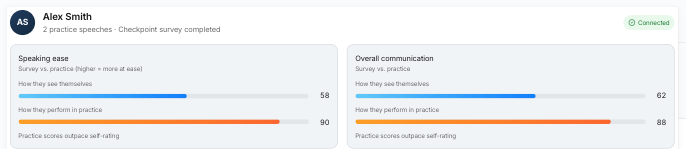
Practice combines performance data with survey-informed Learning Outcomes Inventory indicators for progress tracking, not clinical diagnosis.
AI drafts scores and feedback. Instructors review and save the official grade.
Evaluations map to your rubric categories and point values, not generic advice.
Consent-aware workflows and role-based access for higher education use. Not described as FERPA certified without formal review.
Instructor corrections inform future model training but do not retrain the live production model in real time.
Practice retrieves patterns from real instructor evaluations to generate rubric-aligned feedback for self-directed rehearsal. It combines rubric scores with a dual-source baseline profile (saved speeches plus Learning Outcomes Inventory indicators). Available in limited early access; included for coaching clients during this phase.
Practice provides coaching and progress feedback, not an official course grade, clinical assessment, or diagnostic score.
Schedule a walkthrough for Evaluation, or explore Practice for individual rehearsal.